

Scan Plans
Scanning Construction Plans—for Further Processing and Archiving
Paper plans and construction drawings—neatly scanned and ready for digital use.
When it comes to professional blueprint scanning, resolution isn’t the only factor that matters. We align the originals, optimize contrast and brightness, and select black-and-white, grayscale, or color depending on the source material. This results in easily readable digital blueprints for archiving, documentation, or as a basis for further CAD processing.
Table of Contents
Which plans do we scan?
We scan construction, architectural, and technical drawings of all types and sizes—from individual paper drawings to extensive collections of drawings.
Architecture & Buildings
Floor plans, elevations, sections, construction drawings, as-built drawings, building plans, room layouts, site plans, design drawings
Building Systems
Electrical plans, electrical schematics, plumbing plans, building services plans, lighting plans, fire protection plans, network plans, HVAC plans
Infrastructure & Civil Engineering
Sewer plans, wastewater plans, road plans, utility line plans, pipeline plans, gas pipeline plans, water pipeline plans, cable routes, safety plans
Industry & Mechanical Engineering
Mechanical engineering drawings, technical drawings, design drawings, assembly drawings, detailed drawings, plant layout drawings, piping diagrams, schematics, and engineering drawings
Energy, Utilities & Facilities
Power supply plans, power plant plans, process and procedure diagrams, piping and instrumentation diagrams, network diagrams, utility supply plans, electrical single-line diagrams
Surveying, Landscaping & Interior Finishing
Cadastral maps, site plans, survey maps, landscape and neighborhood plans, interior floor plans, kitchen plans, furniture layouts, sketch plans
Scanning Plans—Here's How We Do It
From a single blueprint to an extensive plan archive: We take the original documents, scan and process them carefully, and return the digital files in the agreed-upon format.
Pickup & Secure Logistics
For larger collections of plans, we will arrange for the pickup and secure transport of your documents upon request.
Even for large planned quantities
We handle individual plans as well as extensive archives and larger, recurring scanning jobs.
Careful processing
The plans are checked, aligned, and optimized for readability, contrast, and presentation based on the template.
Flexible Data Transfer
You will receive the finished files digitally in the agreed-upon format via a transmission method suitable for the data volume.
Confidential Processing
We will treat your plans and documents confidentially and process them solely for the agreed-upon assignment.
Reliable Schedules
We agree on the timeline in advance and coordinate larger projects and milestones with you on a case-by-case basis.
Scan Quality, Resolution, File Format
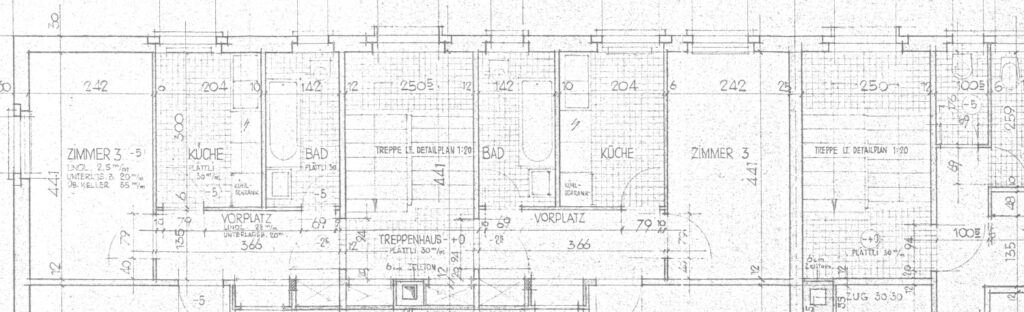
Depending on the condition, format, and intended use, we select the appropriate scan resolution and display settings. The plans are aligned, retouched as needed, and exported in the desired file format.
Breakdown by Purpose
We scan your plans at 300 dpi as standard. Depending on the original document and your requirements, other resolutions are also possible.
Black-and-white, grayscale, or color
The scan mode is selected based on the original document and its intended use.
Plans up to 150 cm wide
With our large-format scanner, we can also scan very wide architectural and technical drawings up to about 150 cm.
Turning, Aligning, and Finishing
Scans are rotated to ensure they are legible, carefully aligned, and, if necessary, optimized for contrast, brightness, and edge areas. Depending on the original document, the background can be reduced or largely removed.
Quality Control & File Formats
Before delivery, we check the readability, orientation, and alignment of the scanned plans. Depending on the intended use, we deliver files in formats such as PDF, PDF/A, TIFF, or JPG.
OCR Text Recognition & Searchable PDFs
Suitable plan scans can be made searchable via OCR upon request. This makes it easier to find text and information. The quality of the recognition depends on the font, the layout of the plan, and the condition of the original document.
Custom Quote for Scanning Your Plans
Please send us some details about the number, format, and condition of your plans—photos or sample scans are often sufficient for an initial assessment. We’ll evaluate the scope of the work and provide you with a personalized quote. For larger quantities of plans and archival collections, we offer customized, volume-based rates.
Estimated prices per plan
Black-and-white: starting at approx. CHF 12.00
Grayscale: starting at approx. CHF 14.00
Color: starting at approx. CHF 16.00
For larger quantities of plans, we offer fixed unit prices.
Customer testimonials on Google: Why our customers value us
Discover why our customers value us! Read authentic reviews on Google and find out how we exceed their expectations with first-class service and expertise. Put your trust in our proven services, which have already won over numerous satisfied customers.
- Tibor Lamoth
Prompt, straightforward, and clean. Professional

Martin RusterholzPrompt and fast service for scanning old construction plans.
Reto Wullschleger WULLSCHLEGER & ACETIAs always, excellent service and quality!
- Beat Halter
I had some old blueprints for a single-family home scanned from paper to PDF. The job was completed quickly and exactly as I had envisioned.
Patrik InglinFriendly, straightforward, efficient and fast.......good work...happy to do it again!
Norbert MüllerPrompt service and impeccable work. Thank you very much, Norbert Müller
- Felix
Super product delivered, we were able to process the data without any problems.
Rolf BaumbergerDelivered digitized very quickly and good plan quality for further processing. That helped us a lot.
Edgar ReichmuthAs always, fast, reliable, and flawless. Highly recommended.
Scan drawings, digitize drawings, or vectorize drawings?
Scan Plans
When you scan a paper plan, it is converted into a digital image file—similar to a photograph. The file consists of many pixels; lines, text, and components are not recognized in the process. The higher the resolution, the more detailed—and usually the larger—the file.
Digitize plans
In a broader sense, even a scan is already digital. At digitalgut, however, digitizing plans means more than that: the contents of the plans are manually captured and reconstructed as structured, editable CAD files—complete with lines, text, dimensions, components, and layers.
Vectorizing Drawings
During vectorization, pixel information from a scan is converted into vector elements such as lines, arcs, and shapes. At digitalgut, this is not done as a blind, automatic conversion, but rather in a controlled manner with the goal of producing a CAD file that can be easily edited.
In summary: Scanning creates a digital image file from a paper drawing. Digitization creates structured and editable CAD data from that image. Vectorization converts raster data into vector elements.
From a plan scan to a CAD file
A scanned drawing initially consists only of pixels and cannot be edited directly in CAD. If the drawing is to be used further, we re-capture the relevant content and use it to create a structured CAD file—for example, as a DWG/DXF or ArchiCAD file.
Frequently Asked Questions About Scanning Plans
At what resolution are plans scanned?
By default, we scan plans at 300 dpi. This resolution is suitable for most applications and offers a good balance between detail and file size. Depending on the original document and its intended use, other resolutions are also possible.
What is the difference between DPI and PPI?
PPI refers to the number of pixels per inch in a digital file. DPI actually refers to the dot density during output, such as when printing. When scanning, however, people usually refer to it as DPI in everyday language. When we say 300 dpi, we mean a scan resolution of 300 pixels per inch.
What file formats are supported?
Depending on the intended use, we deliver the scanned plans in formats such as PDF, PDF/A, TIFF, or JPG. We select the appropriate file format based on the plans’ intended future use, archiving, or further processing.
How wide can the plans be?
With our large-format scanner, we can scan plans up to 60 inches—or about 152 cm—wide. We can also process very long plans measuring several meters, depending on the original.
Can yellowed, soiled, or damaged plans be restored?
Yes, readability can often be significantly improved. Depending on the original, we optimize contrast, brightness, and the edges of the image. Distracting or discolored backgrounds can also be reduced in some cases or largely removed. The possible result always depends on the condition of the original.
Can damaged, fragile, or stiff originals be scanned?
Yes. Our large-format scanner is a continuous-feed scanner, in which the original is fed through the device. If necessary, we can scan delicate or torn paper plans using a protective sleeve. We can also process paper-like materials and certain rigid originals. For sensitive originals, we check in advance to determine which scanning method is most suitable.
Is OCR text recognition possible for scanned plans?
Yes, OCR text recognition is generally possible. How reliably text is recognized depends on the font, scan quality, page layout, and condition of the original document. OCR can be a useful supplement for searching and further processing, especially for large archives.
How much does it cost to scan a blueprint?
As a general guideline, scanning a drawing with us starts at approximately CHF 12.– in black and white, CHF 14.– in grayscale, and CHF 16.– in color. For larger quantities of drawings, we typically agree on fixed unit prices. The exact price depends, among other things, on the quantity, format, condition, and desired post-processing.
What is the difference between scanning and digitizing?
Scanning produces a digital image file, similar to a photograph of the paper drawing. In contrast, drawing digitization involves capturing the drawing’s content anew and reconstructing it as structured, editable CAD data. In common parlance, scanning is already considered a form of digitization; at digitalgut, however, we deliberately distinguish between the two services.
Can scanned plans be converted into CAD files at a later time?
Yes. A plan scan can still be used as the basis for CAD processing even weeks, months, or years later. The key is that the scan must be complete, sufficiently sharp, and as distortion-free as possible. The better the scan quality, the more reliably an editable CAD file can be created from it later.
Can large volumes of documents or entire archives be scanned?
Yes. We process individual plans as well as large collections of plans and entire archives. For larger volumes, we tailor the workflow, logistics, and data transfer to each project and typically agree on fixed unit prices.
How do we get the original plans back, or how does the pickup and return process work?
We will coordinate pickup and return with you on a case-by-case basis, depending on the scope of the job. For larger quantities of plans, we can arrange transportation upon request. Once the job is complete, your originals will be returned to you securely.