

Digitizing Microfilms and Microfilm Cards
Preserving Historical Collections and Making Them Digitally Accessible
We digitize microfilms and microfilm cards for archives, companies, government agencies, and institutions. This helps preserve older collections for the long term, makes them more easily accessible, and allows them to be used without the need for a special reader.
Digitizing Microfilms and Microfilm Cards: Do you still have old microfilms, roll films, microfiches, or punch cards, and would you like to make them digitally accessible again? We can help you digitize construction plans, drawings, and documents stored on microfilm or microfilm cards. This ensures that older collections are preserved for the long term and remain easily accessible for your digital archive. Depending on the material, quantity, and desired outcome, we’ll work with you to find the right solution for your collection.
Table of Contents
Options at a Glance
You bring
Microfilm on reels, microfilm cards, microfiche, jackets, or punch cards.
We'll discuss this with you
The type, condition, and scope of your source materials, as well as the desired digital output and intended future use.
Digitization can include
Scanning, image processing, full-text recognition for suitable material, structured file naming, metadata capture, and data delivery in the agreed-upon format.
Here's How Digitization Works
1. Check inventory
Every microfilm collection is different. That is why we first assess the types of film available, their condition, their size, and the desired digital outcome.
2. Define Requirements
Together, we'll determine the desired file formats, the intended use, and any potential text recognition and data structure.
3. Digitize and process
The documents are scanned professionally. If necessary, the alignment, cropping, contrast, and readability of the scans are optimized.
4. Check Quality and Transfer Data
The files are checked, named as agreed, and made available in the desired structure.
The result: digital files for use and archiving
The output depends on the source material and how you plan to use the content in the future. Depending on the project, the following results, among others, are possible:
- digital image files or multi-page PDF files
- Optimized layout for easy reading
- Full-text recognition with suitable source material
- Structured file naming and metadata collection
- Structured Data Transfer for Your Digital Archive
If the microfilms contain architectural plans or technical drawings, suitable originals can also be converted into editable CAD drawings in a subsequent step.
The output depends on the source material and how you plan to use the content in the future. Depending on the project, the following results, among others, are possible:
– Digital image files or multi-page PDF files
– Optimized display for easy readability
– Full-text recognition for suitable source material
– Structured file naming and metadata capture
– Organized data transfer for your digital archive
If the microfilms contain architectural plans or technical drawings, suitable originals can also be converted into editable CAD drawings in a subsequent step.
Digitizing Microfilms and Microfilm Cards: Request a Quote
Please send us some details and, if possible, photos of your inventory. We will review the type and scope of the source materials as well as the desired digital output and prepare a customized quote for you.
OCR Text Recognition for Searchable Content
If microfilms or microfilm cards contain legible, printed text, the digitized content can be made searchable using OCR text recognition. This makes it possible to find terms, names, or other information more quickly in large collections.
Whether reliable text recognition is possible depends on the quality, contrast, font, and reduction ratio of the original document. For this reason, the suitability of the available microfilms is assessed in advance.
Metadata Collection—With AI Support Upon Request
Digital files are particularly valuable when the information they contain can be found quickly and clearly identified. Depending on the collection and intended use, appropriate metadata can therefore be recorded and linked to the digitized files.
Possible examples include:
- Structured and consistent filenames
- Recording Customer-Specific Information Fields
- Importing Existing Directories or Customer Tables
- Classification by document type, content, date, or other characteristics
- Preparing Data for an Existing Archive or Document Management System
For suitable datasets, OCR and AI can assist with the recognition, classification, and structuring of information. The source material and the desired data structure are used to determine which data can be captured automatically and where manual verification is necessary.
Additional Services
Does your archive consist of paper documents or large-format plans in addition to microfilms? Learn more about our services for digitizing archivesand digitizing paper plans.
Digitizing Microfilms and Microfilm Cards: Frequently Asked Questions
What is the difference between microfilm, microfiche, and microfilm cards?
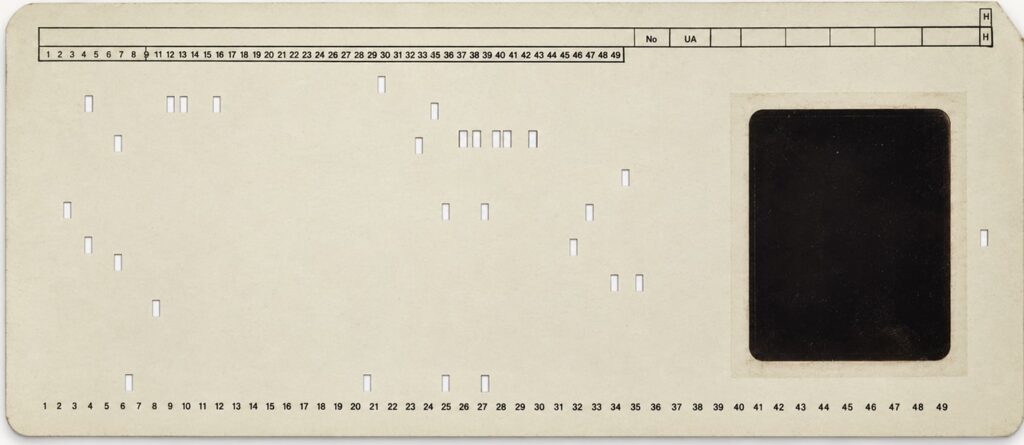
Microfilms are often available as 16-mm or 35-mm roll film and contain a sequence of images. Microfiches are flat sheets of film on which several reduced-size images are usually arranged. Depending on the type, microfilm cards may contain a single image—for example, a blueprint on a perforated film card—or an arrangement of several images. Based on a photo, we can usually quickly identify the type of film involved.
What types of content can be digitized from microfilm?
For example, construction plans, technical drawings, files, documents, and other archived information stored on microfilm or microfilm cards can be digitized.
In what file formats is the data provided?
The appropriate file format depends on the source material and the intended use. Possible formats include PDF, TIFF, or JPG files. The desired output format is determined before the project begins.
Is OCR text recognition possible?
For legible, printed text documents, OCR text recognition generally yields very good results. This allows the digitized content to be searched and the text to be processed further. The quality of the recognition depends primarily on the scan quality, the quality of the original microfilm recording, the contrast, the degree of reduction, and the font used. Handwritten content must be evaluated separately.
What information do you need to provide a quote?
It is helpful to provide information about the type of film, the approximate quantity, and the desired digital output. If possible, please send us a few photos of the collection. This will allow us to better estimate the effort involved and suggest the appropriate solution.
Can older or damaged microfilms also be digitized?
That depends on the condition of the film and the legibility of the images. Photos provide an initial assessment. If necessary, the quality achievable during digitization can be evaluated through a sample review or a test scan.
Can architectural plans on microfilm also be created as editable CAD drawings?
Yes. Suitable digitized construction plans and technical drawings can be converted into structured, editable CAD drawings in an additional step. The amount of work involved depends on the quality and complexity of the source document.
For the technical digitization process, we collaborate with BSB Mikrografie in Basel.